Heat Recovery
Mechanical Ventilation with Heat Recovery (MVHR) is a whole-house ventilation system designed to provide continuous fresh air while minimising heat loss.
As homes have become more airtight and better insulated, traditional “background ventilation” through gaps and trickle vents is no longer sufficient. MVHR replaces uncontrolled air leakage with a carefully designed, energy-efficient system that maintains indoor air quality without sacrificing warmth.
Although commonly associated with ultra-low-energy homes and standards developed by the Passivhaus Institute, MVHR is increasingly used in mainstream residential construction.
Why Modern Homes Need MVHR
Historically, buildings were naturally ventilated
through leakage and passive ventilation like air bricks and trickle vents. Air
moved in and out via chimneys, suspended floors, window gaps, and non-airtight
materials.
While inefficient from a heating perspective, this constant air
movement removed moisture and pollutants.
Modern construction aims to reduce heat loss by
making homes airtight. This significantly lowers energy demand, but it also
traps moisture, carbon dioxide, potentially dangerous substances and everyday
pollutants inside the building. Without a dedicated ventilation strategy,
airtight homes are prone to condensation, mould growth, and degraded indoor air
quality.
MVHR
addresses this issue by delivering controlled, continuous ventilation. Instead
of relying on accidental leakage, air movement becomes deliberate and balanced.
How an MVHR System Works
At the centre of the system is a mechanical unit containing two fans and a heat exchanger. One fan extracts stale air from bathrooms, kitchens, and utility rooms. The other simultaneously draws fresh air from outside and supplies it to living rooms and bedrooms.
The extracted warm air passes through one side of a heat exchanger core, while incoming cold air passes through the other side. Heat transfers across thin plates inside the exchanger, but the two air streams never mix. Because of this exchange, the system recovers heat that would otherwise be lost with the outgoing air.
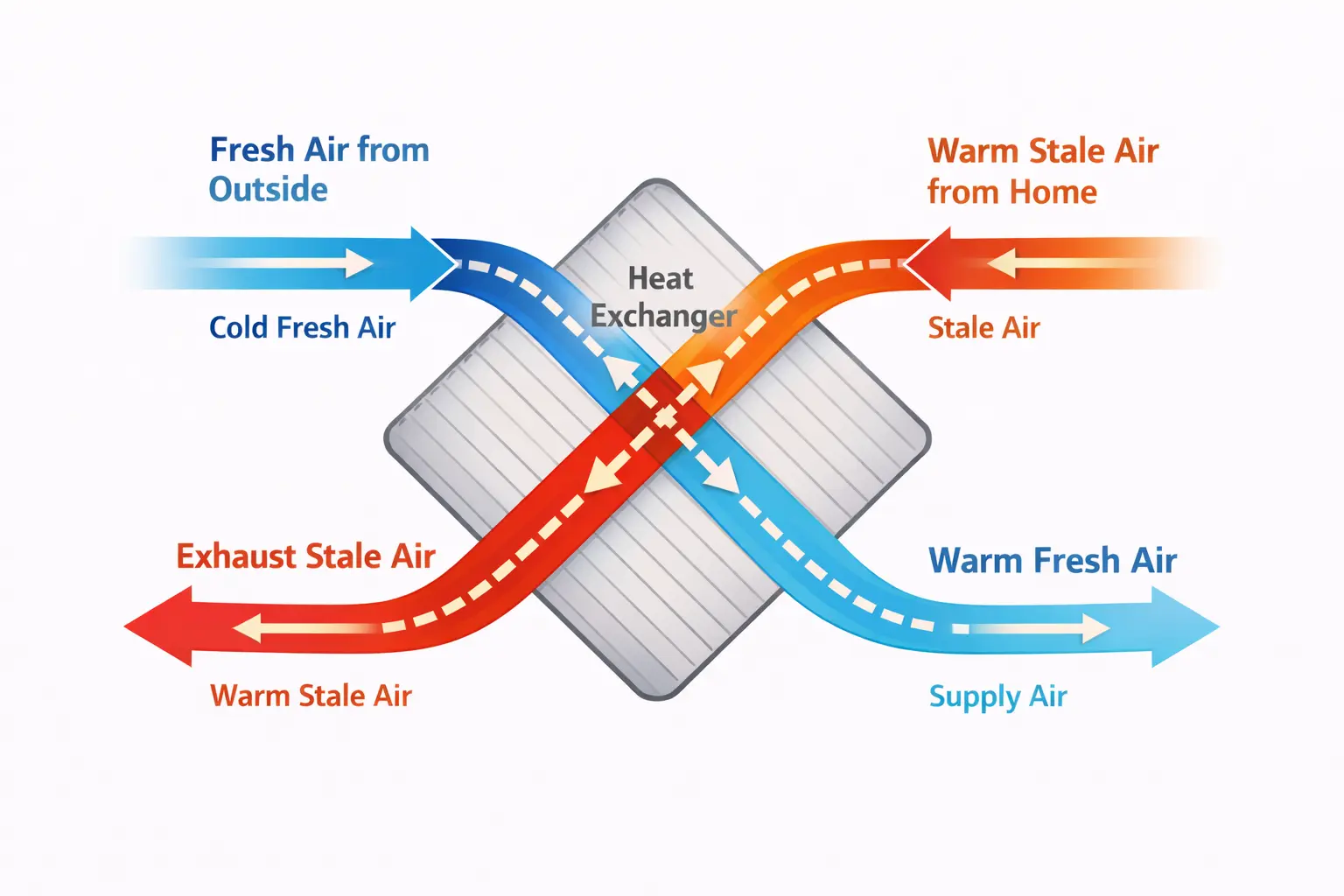
Modern units commonly achieve heat recovery efficiencies between 75 and 95 percent. This does not mean the system heats the house; rather, it significantly reduces the amount of heating energy required to maintain comfortable temperatures.
A network of ducts distributes air throughout the property. Proper design of this ductwork is essential, as poor layouts can lead to noise, pressure imbalances, or reduced efficiency. When correctly installed and commissioned, airflow is balanced so that supply and extract volumes match, maintaining neutral pressure within the home.
Energy Efficiency and Reduced Heat Loss
In an airtight dwelling, ventilation can account for a substantial proportion of total heat loss. Opening windows or relying on extract-only systems removes warm air without recovering any of its energy. MVHR changes this dynamic by capturing most of that heat and transferring it to incoming fresh air.
The result is a measurable reduction in heating demand. In highly insulated homes, this can allow for smaller heating systems and improved energy performance ratings. Over time, reduced heating loads can translate into lower energy bills and decreased carbon emissions.
The more airtight the building, the more effective the heat recovery becomes. In very leaky homes, warm air bypasses the system through uncontrolled gaps, limiting the benefit.
Historically, buildings were naturally ventilated
through leakage and passive ventilation like air bricks and trickle vents. Air
moved in and out via chimneys, suspended floors, window gaps, and non-airtight
materials.
While inefficient from a heating perspective, this constant air
movement removed moisture and pollutants.
Modern construction aims to reduce heat loss by
making homes airtight. This significantly lowers energy demand, but it also
traps moisture, carbon dioxide, potentially dangerous substances and everyday
pollutants inside the building. Without a dedicated ventilation strategy,
airtight homes are prone to condensation, mould growth, and degraded indoor air
quality.
MVHR
addresses this issue by delivering controlled, continuous ventilation. Instead
of relying on accidental leakage, air movement becomes deliberate and balanced.
Indoor Air Quality and Health Benefits
Continuous mechanical ventilation ensures a steady supply of fresh air throughout the day and night. Unlike window ventilation, it is not dependent on human interaction or good weather conditions. This allows fresh air and ventilation all year round.

Incoming air passes through filters that remove dust, pollen, insects, and larger particles. In urban areas, upgraded filters can also reduce very fine particle pollution. For people with allergies or respiratory sensitivities, this filtered supply air can significantly improve home comfort and health.
Because stale air is constantly removed from wet rooms, humidity levels remain stable. Moisture generated from showering, cooking, and drying clothes is extracted before it can condense on cold surfaces. This reduces the likelihood of mould growth and protects both the building fabric and occupant health.
Comfort and Acoustic Performance
A well-designed MVHR system contributes to thermal stability. Supply air enters rooms at a temperature close to the indoor setpoint, so occupants do not experience cold draughts. Temperatures remain more even throughout the home, reducing fluctuations that can occur with intermittent ventilation.
An additional benefit is sound reduction. Because fresh air is provided mechanically, windows can remain closed for much of the year. This reduces intrusion from traffic, aircraft, or other outdoor noises, particularly in busy built up areas.
Suitability and Building Requirements
MVHR performs best in airtight, well-insulated buildings. It is particularly effective in new builds designed with airtightness in mind, deep retrofits where air leakage has been substantially reduced, and projects targeting advanced energy performance standards.
In properties with high air leakage and minimal insulation, the system’s effectiveness is limited. Before considering MVHR in an older home, improvements to airtightness and thermal performance are usually necessary to justify the investment.

The location of the unit also requires planning. It is typically installed in a utility room, plant space, or loft area with provision for condensate drainage and access for maintenance. Early design coordination is crucial to accommodate duct runs without compromising ceiling heights or structural elements.
Installation and Commissioning
The performance of an MVHR system depends heavily on correct design and commissioning. Airflow rates must be calculated according to occupancy and floor area. Duct sizing must minimise resistance and prevent excessive fan energy use.
After installation, the system must be balanced using airflow measurement equipment. Each supply and extract valve is adjusted to achieve the intended design rates. Without proper commissioning, even a high-quality unit will not perform as expected.
Costs and Long-Term Value
Installation costs vary depending on house size, complexity, and whether the project is a new build or retrofit. New build installations are typically more economical because duct routes can be integrated into the design from the outset. Retrofits often involve more disruption and additional labour.
While the upfront cost is higher than basic extract systems, MVHR delivers long-term value through energy savings, improved air quality, and enhanced building durability. In high-performance homes, it is often considered an essential component rather than an optional upgrade.
Common Misunderstandings
It is important to clarify that MVHR does not replace a heating system. It reduces heat loss but does not generate heat. Windows can still be opened whenever desired, although the system works most efficiently when the building envelope remains closed.
Concerns about noise are usually linked to poor design or installation. Properly specified systems operate quietly, with airflow rates carefully controlled to avoid draughts or audible disturbance.